


If you’re interested in dilation, you’ve already taken the first steps towards success by doing research on important topics—like when to switch sizes!
Dilation may seem simple and easy, but it is possible to go about it incorrectly. Trying to rush the process or move up in dilator sizes too soon can result in pain or even injury. This blog looks to provide tips for switching dilator sizes and how to tell when you’re ready to do so!
However, actually progressing to the next size may be easier said than done for some. If you aren’t seeing any progress with dilation, feeling “stuck” on a size, or are just unsure where to start, book an appointment with me! I can help get you on the right track.
So, how do you know when it’s time to move up in size? Let’s jump right in!
Switching Dilator Sizes and Listening to Your Body
Many people trying dilation might think that the process is a very straightforward or linear experience. Perhaps you’re thinking something like: “I’ve been using this size for a few weeks, can I try the larger size now?”
Moving up in dilator size is not necessarily based on time or how long you’ve used a certain size for. Regardless of how long you’ve been practicing with a size, what really matters is your comfort and your body’s response. Ideally, you should only move up in size once you are completely comfortable with your current dilator size.
“Completely comfortable” means all aspects of dilation feels painless; including insertion, the advancement or movement inwards, the movement outwards, and actual removal. You should feel little to no discomfort during any of these movements!
You should also feel little to no discomfort during mobilizations. If you didn’t know, mobilizations refer to movements of your dilator. This can include:
- Moving the dilator slightly inwards and outwards carefully
- Slowly turning the dilator clockwise or counterclockwise
- Pressing the dilator towards different directions while inserted
As long as there is no discomfort during full insertion or mobilizations, you are likely ready to move on to your next size. However, it is important to consider how you feel after dilation, too.

Experiencing minor discomfort for a few hours after dilation is normal, but this pain should be less than a four out of ten and should not affect your ADLs, which are daily activities like using the restroom, bathing, walking, etc. These symptoms should fade within 24 hours.
Watching for these effects is very important! Think of it similarly to lifting weights. The next day, it is normal to have sensations or light soreness in your muscles. But if you cannot lift items normally or sit down without falling into your seat, you have overworked yourself.
Similarly, you should not be so sore from dilation that normal daily activities are impacted. It’s very important to approach dilation slowly and carefully so that you do not injure yourself. You can always work alongside a pelvic floor therapist if you are afraid of moving too fast.
Depending on your dilation needs, you may be working with a doctor already. Your doctor may have recommendations for when to move up in size, so be sure to follow their instructions and guidance.
But remember, no matter what your needs are, dilation is a slow process! You can expect it to take many weeks for you to become completely comfortable with a dilator size, regardless of the type of dilation you are doing.
How to Safely Switch Dilator Sizes
Switching dilators might seem simple—just use the next largest size, right? Well, not necessarily. Switching abruptly like this can be painful, so you’ll want to work your way up to the next size.
You can do this by starting with your current size first, allowing your body to “warm up” with this size for a few minutes, then move on to the next size up. If it is still a bit too difficult to move up to the next size dilator, you may need to practice initial insertion with just the tip first.
Practicing full insertion with the previous size first will not only allow your tissues to warm up but can also help maintain the depth you’ve achieved while you begin practicing insertion with the next size.
This process allows you to slowly and safely move your way up to full insertion with the new size without too much of a jump, especially if you do not own every incremental dilator size. Going slowly will help maintain your confidence during dilation and minimize discomfort!
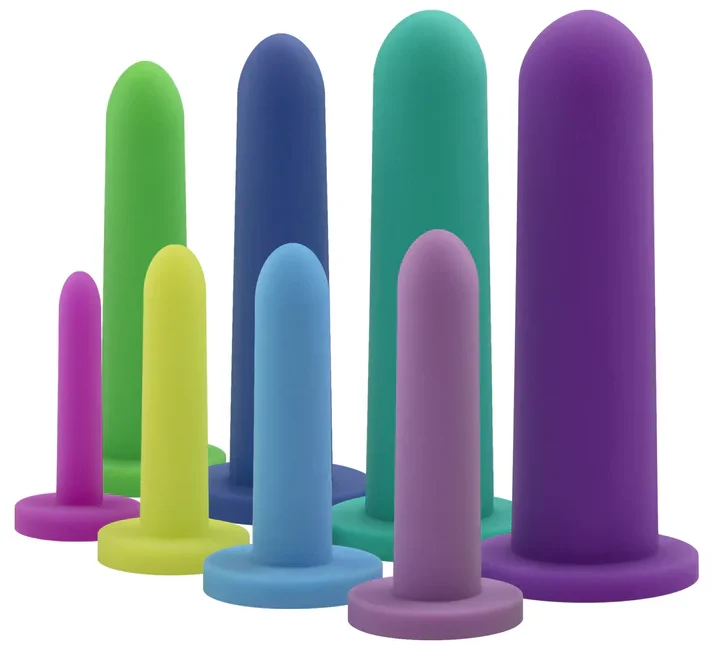
So, what does switching dilator sizes look like in practice?
Although we mentioned that switching to a larger size is not entirely determined by how long you’ve used a dilator for, timing can still be a helpful indicator to track progress (it just shouldn’t be the only indicator for moving up in size).
After all, dilation practice typically involves holding the dilator for longer and longer insertion times as you become more comfortable with each size.
Let’s look at an example…
Example Dilation Scenario
Say for example you are starting at the smallest dilator size (size one). You started with holding for five minutes, and have gradually worked your way up to fifteen minutes over the course of several sessions. During this time, you implemented mobilizations like twisting, in and out movements, and other tissue stretching techniques.
You feel completely comfortable with size one, and are ready to move on to size two during your next session.
To do this, you’ll start by warming up with size one for five minutes. Next, you’ll use size two for five minutes. If this goes well, you’ll slightly increase the amount of time you hold size two for during your next session; for example, warm up with size one for five minutes and then hold size two for six minutes this time.
You’ll continue this process of warming up with size one and increasing holding time with size two until you reach 15 minutes again.
Now that you can handle holding size two, and feel no pain with insertion, movement inwards, movement outwards, removal, and mobilizations, you can move up in size again at your next session!
This means you’ll discontinue size one, and will instead use size two as your new warm up dilator.
Dilation Troubleshooting
As with every other aspect of dilation, you can always work through difficulties with a physical therapist. Managing dilation on your own can be intimidating—tracking progress, moving up in size, managing setbacks, and more. Don’t hesitate to book a consultation if you need some professional guidance.
Now, continuing with the example scenario from above, let’s say that you have trouble during your five-minute warm up. When setbacks like this happen you can experiment with a few different alternatives, such as:
- Trying a ten-minute warm up with the smaller dilator
- Add tissue stretching during your warm-up
- A combination of both a longer warm-up and tissue stretching
Or, in another example, let’s say you experience pain during practice, but only with the initial insertion. In other words, the initial insertion may hurt some, but full insertion isn’t a problem. In this case, how do you know when you should move up in size?
You should not move up in dilator size if the pain with insertion is a three or higher out of ten. Dilation can be a little uncomfortable, but you should not experience significant pain. Pushing through pain will only risk injury and can even set you back further, so remember to be patient and take things slowly.
If pain with the initial insertion is a common problem as you move up in size, you may need to try more mobilizations that focus on the vaginal or rectal opening. You can also try the alternatives listed above.
Keep in mind that the larger dilators will usually require more time to progress through than the smaller sizes, so don’t feel discouraged as you practice.
Start Dilation at Your Own Pace
Starting dilation can be intimidating, but the process allows you to be in complete control—meaning you can choose how slowly to begin. What really matters for progress is consistency, not rushing through dilator sizes or pushing through pain (which is actually more harmful than anything).
If you have trouble from the very beginning, remember that you don’t necessarily have to insert the entire length of the dilator. Some people struggle more with initial insertion, as mentioned earlier. Work your way up to full insertion at your own pace, and take your time when moving up to the next size, too.
Dilation isn’t something you have to rush. Take the time to relax and gain a better connection with your body!

Still Feel Stuck? Work With Me!
Dilation is not always an easy process, despite how it may seem. Many people may feel scared to begin, struggle to dilate effectively, or find themselves getting “stuck” on a dilator size. If you are dealing with any dilation problems or obstacles, I invite you to work with me!
Experiencing troubles with dilation or struggling with pelvic floor symptoms are signs that your body needs more than just dilation therapy.
With a proper evaluation, I can determine the current health of your pelvic floor—such as its flexibility, function, coordination, tension, and more. This will allow me to create a suitable dilation plan just for your needs, as well as a comprehensive treatment plan that will encourage progress.
I can utilize additional treatments like manual therapy, exercise prescription, neuromuscular re-education, and more; all of which can help reduce pelvic floor tension, improve your pelvic floor control, and allow your dilation practice to go smoother.
Have appointment questions? Try a free discovery call!