


What Is a Prostatectomy?
A prostatectomy refers to a procedure that removes some or all of the prostate gland. This gland is found only in the reproductive system of those born with a penis. It is located below the bladder, and surrounds a portion of the urethra.
This small gland is responsible for creating some of the fluid that makes up semen, as well as helping to push that semen through the urethra during orgasm. While this gland primarily plays a role in sexual health, it can also impact urinary health!
When the prostate begins to cause urinary or sexual dysfunctions, prostatectomy is not usually the first choice of treatment. Treatment can greatly depend on your individual needs and situation, and what root cause is affecting your prostate.
In the next section, we’ll briefly discuss the most common conditions that may lead to prostatectomy.
What Makes Prostatectomy Necessary?
There are two main factors that can create the need for a prostatectomy: Benign prostatic hyperplasia (BPH) and prostate cancer. Prostatectomies are not the only treatments used for these conditions, but can be an option for certain situations or needs.
Let’s look at each condition individually below!
Benign Prostatic Hyperplasia: This condition refers to an enlarged prostate, which is something that commonly happens with age. An enlarged prostate can put pressure on the bladder and urethra, which causes a variety of urinary struggles. BPH is not always treated with prostatectomy, but surgery may be considered in more severe cases.
Prostate Cancer: Prostate cancer is a common form of cancer that affects urinary and sexual function. In most cases, this cancer is found early and has successful treatment. One form of treatment commonly used in early stages where the cancer has not spread outside of the prostate is prostatectomy.
Your Prostate and Your Pelvic Floor
To understand how pelvic floor physical therapy can support your prostatectomy, you’ll first need to understand the connection between your prostate and your pelvic floor.
The pelvic floor refers to a group of muscles located within your pelvis. These muscles connect to and affect a lot of different structures, such as your bowels and bladder. Your rectum and urethra pass through your pelvic floor, and the prostate lies within your pelvic floor, too.
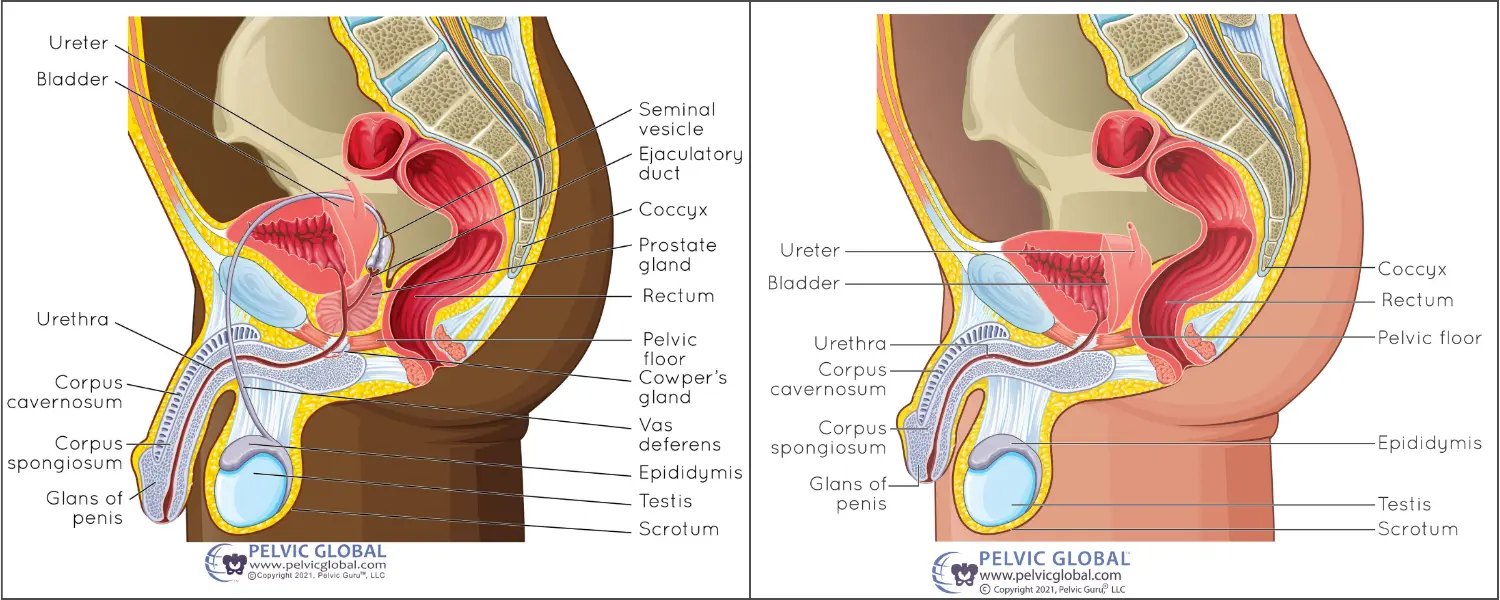
Your pelvic floor isn’t just connected to your pelvic organs… it connects to larger structures, too. Your pelvic floor forms the base of your abdominals and interconnects with your hips and lower back. Additionally, your perineum and perineal body are situated in the pelvic floor.
Your pelvic floor has a lot of jobs—it supports your upper body weight and movements, which allows you to have stability and balance.
It controls the continence of your bladder and bowels, which allows you to go to the restroom without complications. It also affects sexual function and appreciation, allowing for things like sensation, erection, and ejaculation.
When the pelvic floor muscles are too tight, weak, inflexible, or uncoordinated, it’s known as pelvic floor dysfunction. Due to how interconnected the pelvic floor is with so many different pelvic organs and structures, pelvic floor dysfunction can directly affect the prostate and other organs’ functions.
In other words, pelvic floor dysfunction can cause a variety of symptoms including sexual dysfunctions, urinary concerns, bowel concerns, and more.
Pelvic floor dysfunction can be caused by a wide variety of factors. One factor that can significantly impact the pelvic floor’s health, mobility, flexibility, and function is surgery (such as prostatectomy). Prostatectomy disrupts pelvic floor function due to the use of incisions and removal of inner structures, which causes trauma to the nearby tissues.
Surgery doesn’t just cause trauma to your tissues and muscles—it also creates scar tissue. Prostatectomy can involve incisions in the abdomen or perineum, which would directly affect the pelvic floor. These incisions can leave external scar tissue that can restrict the flexibility and mobility of your tissues and pelvic floor.
Internal scar tissues (adhesions) are another possibility with any pelvic surgery. Any type of scar tissue can cause significant tension and restrictions in the pelvis, which can lead to symptoms of pelvic floor dysfunction.
Pelvic floor dysfunction isn’t something that occurs only after surgery. In fact, you may already have it alongside your BPH or prostate cancer. These conditions put a lot of strain and pressure onto your pelvic floor, so it isn’t uncommon to have both. The symptoms easily overlap, too. Unfortunately, pelvic floor dysfunction can worsen your symptoms and complicate the healing process post-prostatectomy.
So, what can you do to reduce the risk of post-surgical complications and encourage better pelvic floor function after a prostatectomy? The answer is pelvic floor physical therapy, which we’ll discuss next!
How Pelvic Floor Physical Therapy Can Help
Pelvic floor physical therapy plays an essential role in supporting prostatectomy. It can help you prepare your body for surgery beforehand to increase your chances of a smoother recovery, and rehabilitate your body post-surgery to address dysfunctions and other effects of surgery.
For those with benign prostatic hyperplasia, pelvic floor physical therapy can help manage your symptoms in the long term. In some cases, pelvic floor therapy can prevent the need for surgery entirely—especially if your symptoms are being worsened by pelvic floor dysfunction (and are not entirely attributed to a large prostate).
However, even in cases where surgery is deemed necessary for BPH, pelvic floor physical therapy is a necessary step in preparation, rehabilitation, and the prevention of long-lasting dysfunction!
Let’s dive in deeper to the role of pelvic floor physical therapy for these different scenarios:
Post-Prostatectomy Rehabilitation
In the case that surgery is deemed necessary for your case (for either BPH or prostate cancer), pelvic floor therapy is absolutely essential! After all, your body will need proper rehabilitation post-surgery.
This is because prostatectomy causes a lot of trauma to the tissues and muscles of the pelvic floor. These structures may be weak and lacking in coordination even after the initial healing period.
Failing to properly restore strength and mobility to the pelvic floor post-surgery can result in long-term symptoms of sexual and urinary dysfunction.
While situations involving cancer can be unpredictable, committing to pelvic floor physical therapy can help reduce your risk of post-surgical complications and may prevent unideal, long-term symptoms.
Not to mention, pelvic floor physical therapy is very safe and has shown to be effective for most people. Therefore, you have nothing to lose and much to gain by engaging in physical therapy!
This doesn’t only apply to those who have had a recent surgery—if you’ve had a prostatectomy in the past and are still experiencing urinary or sexual dysfunction, you should definitely consider making an appointment so that I can determine if your symptoms could be attributed to pelvic floor dysfunction.
Prostatectomy can unfortunately cause long-term effects, but pelvic floor dysfunction is very treatable, so it doesn’t hurt to see if this is a possible cause of your symptoms!
Pre-Prostatectomy Preparation
Did you know that you could prepare your pelvic floor muscles before surgery, too? With any kind of pelvic surgery, prepping your pelvic floor muscles beforehand can provide significant benefits!
As mentioned earlier, conditions like benign prostatic hyperplasia or prostate cancer can lead to pelvic floor dysfunction—along with a wide variety of other causes.
By seeing a pelvic floor physical therapist (like me!) before your prostatectomy, you can get your pelvic floor muscles in better health and address any current dysfunctions, which will allow for a much smoother healing period.
It’s very beneficial to address dysfunctions before surgery, rather than afterwards when you’re healing. Surgery will only worsen your dysfunctions, so getting your pelvic floor in good shape beforehand will make your healing experience and rehabilitation much easier.
Not only can pre-surgical preparation help make your recovery period smoother, but it can reduce the risk of post-surgical complications and other symptoms of pelvic floor dysfunction, too.
Another perk not many will consider is that engaging in physical therapy before your surgery will help you become accustomed to the process early, rather than learning how physical therapy works while you are still healing. This will help you better understand your pelvic floor and how to engage it during treatment, which will make post-surgical rehabilitation much easier.

Managing an Enlarged Prostate
For those with an enlarged prostate (benign prostatic hyperplasia), prostatectomy is not always needed. In most cases, other less invasive treatments are tried first to provide relief from symptoms, including pelvic floor physical therapy!
If you remember the connections between the pelvic floor and the prostate that we discussed earlier, this should make sense. If you have an enlarged prostate, your pelvic floor is usually affected, too. The constant straining and struggles during urination can have a significant impact on your pelvic floor, and can create pelvic floor dysfunction.
This means that your symptoms are not necessarily caused by your prostate alone—they’re being worsened by pelvic floor dysfunction. Luckily, for many people, pelvic floor physical therapy is a safe and effective way to relieve these symptoms.
By reducing tension and improving the overall health of the pelvic floor, the pressure being put on your bladder and urethra can be reduced. This can improve your ability to control your bladder, urinate, and engage in sexual activities.
For some, this can make BPH more manageable in the long term and may even make surgery unnecessary! However, I am always prepared to work with other professionals as needed to be sure that your plan of care is comprehensive and holistic.
No matter what your needs are when it comes to your prostate, pelvic floor physical therapy can provide plenty of support and tons of benefits.
If you’re ready to get started with pelvic floor physical therapy, make an appointment! I offer both in-person and virtual sessions for people of all ages and gender identities. You can also check out the discovery call option for more information!